I flew my bird on Saturday morning, having a few hours before I needed to take my "reboot" nap, as I was scheduled for a work night. It was at one of my closer locations, not too large, but with plenty of bunnies to offer several slips. Well, several slips we did have, but just didn't connect for anything to take home in the bag. Her weight was a bit high. The greater disappointment came when after the hunt and call down, I discovered her transmitter had fallen off.
How does a heavy-duty zip tie just break?
I put her away into her giant hood in the car, then got out the receiver and yagi. I was happy to get a ping fairly close to the car, but as you can see above, the cover is challenging. It truly would be like trying to find the proverbial needle in a haystack. I followed the signal and isolated an area, but casting about on this cloudy day, I just did not see the brightly-colored tape I've marked the transmitter with. Time was pressing, and I had to give up.
I ruminated about it all evening.
The following morning I was just too tired to even think of attempting a "fox hunt". That is what I have learned the amateur radio enthusiasts call hiding a little transmitter and then inviting their club members to locate it. I went home and slept a few hours, then tried to tackle this challenge a little more rested. I also pulled out my more compact yagi (antenna), as well as practiced just a little in my driveway with a different transmitter to get a feel on how my equipment would work receiving the signal from a device on the ground.
I returned to the location I had given up on the previous day. I was happy to see the battery was still working. It was slower, but still beeping. I had also brought ear buds so I could attenuate my receiver down, for finer locating once you get close to an object. The light was better, and to my delight, I found it within about 3 minutes.
Hoorah!!!!
I have lost this transmitter before, and found it. It's not pretty, but it is a favorite of mine. I won it at a NAFA meet a few years prior. It is called a "cheap beep". A falconer who is also an amateur radio enthusiast was making these inexpensive transmitters. I won one and bought one. I lost one when the bird attached to it headed for the hills during a hunt and I could not follow for the very same reason above - had to quit to take a nap prior to work. It didn't help either that the following overnight had a blizzard roll in that shut the whole area down for a few days. That transmitter was lost along with the bird. I have also purchased a kit to make one, but it remains unassembled as neither I nor Rich seem to have the right tools.
I am happy to have it back. I really should cut a leather bewit to attach to the bird instead of zip ties. Or better still, eventually put a back pack on my hawk so she can wear a transmitter up high and out of the way on her back. I'll wait on that option to see whether or not she will be a bird worth keeping for a few seasons. Back pack installation is tricky, and not something the bird will sit still for. I'll save that stress for both me and the bird for a later day.
Shortly after returning from my trip to Kansas, taken for fun, but also because a wider variety of color morphs come into that area, and coming back home empty-handed, I just happened to stumble upon my new bird for the season. My husband has been participating in an auction for the last half year which has him pick up his "treasures" from Hutchison, Minnesota, which is a 3-hour drive one way from our home. When I am off and available, I tag along. On his run at the beginning of October, driving through Glencoe, I spotted this bird at a distance on a telephone pole. We routed around closer, dropped the trap, and she came right away. She was 1427 off the trap, a very substantial female, no doubt! She was hanging out next to a Seneca food plant, and the name just sounded appropriate, so that is what I tagged her.
We visited our friends Foxfeather and Roman on our way home to attach her permanent equipment, and for the initial manning. Below is the typical "derpy" new hawk expression.
FOOT PORN!!!! We falconers like to show off those impressive toes!
The bird is not so impressed, but she'll come around!
The next morning, showing off her back profile. She is feather perfect, except for a little mutes (hawk poop) on the tail. She is a standard Eastern morph Red Tailed Hawk. Nothing fancy, but still beautiful!
Becoming friends requires calming her down and assuring her that I am not going to hurt her. We call this "manning". I find using a feather helps as being touched with one is something that has happened all during her time in the nest.
⇓⇓⇓⇓ Ooop! Language Alert!! ⇓⇓⇓⇓
As one friend described it, she is a "Chonkasaurus"!
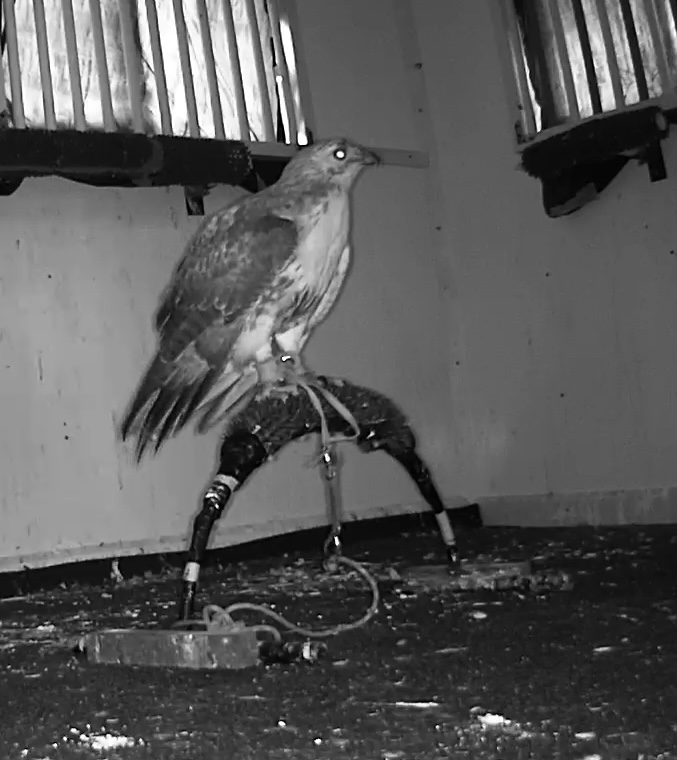
She has certainly been the first most surveilled bird I have had. I have set up several WYZE cams around my home, to include for my hawks. She was watched closely when on her own. The image below is actually in a totally dark room. Night vision on the camera is quite convenient.
The below image is her after training and getting comfortable in her outdoor weathering yard with jump box. She can sit and watch the world go by, and then tuck herself into the bottom portion out of the wind and weather if I choose to leave her out overnight. I can check in at any time with an app on my cell phone.
She seems to be pretty smart, as far as a hawk goes. She calmed down fairly quick, and realized I would feed her. Most birds can be moved through the training process in as few as three weeks. It took just a little longer with Seneca, mostly because I needed to shave some weight off of her. She was also receiving treatment after a visit to the Raptor Center for some mild parasites and Asper prevention.
All during the training inside and then outside, she responded very quickly while all the safety equipment was still engaged (creance). Once I felt she was at a good weight to try free flying, she showed she was still not completely safe. The week prior to the day of her success she was flown several times, all mostly resulting in her taking a high perch and not responding or following very good. Just a little more weight needed to come off.
Creance flights in several locations helps to get her used to being weighed, then placed in a box, then going some other place and flying, and getting fed.
In recent years I have sometimes doubted my status as a "Master" falconer. I faced certain challenges with my passage Harris Hawk, which eventually resulted in my decision to let her go. I have had successes in the past with many other hawks, but constantly question myself if I am doing right by my bird, employing the best tactics for success and their safety. It is actually amazing to me sometimes the "software" present in a hawk's brain that allows us to establish this relationship with them. It is in their nature to overcome the strangeness of being taken into captivity, and all the weird things that happen to them, to include loss of freedom, equipment attached to them, human activity around them. I think the most amazing thing is their capacity to learn to take advantage of our efforts to help them hunt, their tendency towards opportunism. Over this past week my new Seneca was not quite making the connection of my efforts in the field to stir up the game for her. On Tuesday, November 16, World Falconry Day, and six weeks since initial trapping, hopefully she made the connection.
We flew her at Sprague Park, in Caledonia, on a day we had errands that included visiting Rich's family farm. At first, again, she was being pretty sticky in the trees and not following me, however after being in the field, and her moving a bit more in the trees to move up and be closer to me, I kicked up a bunny that ran for the next county. She came racing from her lofty perch behind me, pursued it for quite a distance in front of me, into a brushy ravine. I slowly followed and systematically worked the brush, either moving around that same bunny, or others hiding there. She kept fairly close to me, and ended up sealing the deal with a young, smallish bunny. I let her stuff herself silly for the first time under my care. Hopefully she has made the critical connection to stay near to me, as that is where the bunnies will be kicked out. This intervention on the ground is something the wild birds learn from following farm equipment. I hope she realizes she can treat me like some kind of slow-moving (emphasis on SLOW) field vehicle that makes food more easily available.
A bird trapped and trained and taken for falconry does not actually BECOME a falconry bird until it has taken game. Today, Seneca earned her title.
The fall migration has been slow to start this year. In years past, my not so reliable memory recalls by September you could regularly see passage birds, young red tailed hawks, flying through, allowing for trapping for the falconry season. I love this season! I look forward to it. I pay attention to hawks in my environment (just ask my husband). It has been unseasonably warm. The cold that starts to push young birds to fly away from their natal territory has not happened yet.
At the beginning of the year we are required to pick our Priority Vacation at work. This is your choice that you almost certainly are assured will be approved. I always pick late September / early October as that is when I am chasing hawks. As this time approached I was still not seeing many young birds at all. I decided I would increase my chances at finding passage birds, and also waste a bunch of gas on a road trip, and seek a permit to trap in Kansas. That state is one of the easiest to secure an out-of-state trap permit, and in the prime of the migration tends to soak up a lot of birds flowing out of the North, just based on the geography of the region.
I did not anticipate that the very same forces that were delaying the flow of the migration through my area in Minnesota were also at play in Kansas. After my trip, and a lot of miles on my car, I came away empty-handed.
However, the trip was not a complete loss. I saw a life-bird! I have wanted to see a Ferruginous Hawk in the wild, which do not occur in my Eastern zone. These are a Western species, that does come into Western Kansas. Part of my goal was to see, and maybe even attempt to trap one. I at least saw one!
My journey began on Wednesday the 29th of September. After finishing up some final tasks I had to do at home I got myself down the road. My goal was to arrive in the far Northeast corner of Kansas by the evening, so I could start looking and trapping the very next day. I took I90 West from home until it intersected I35 at Albert Lea. I took this South all through Iowa. At one point I got off the interstate highway to fuel up, and just so happened to stumble across one of the covered bridges of Madison county.
This one was at St. Charles, Iowa. I had to send a picture home to my friends and comment that I had been driving all morning, and yet still found myself in St. Charles.
OK, back on the road, and finish up driving through Iowa. I would cross over and drive in Missouri for about an hour before taking state highway 36 West to arrive to Saint Joseph. My plan was to stay the night in Saint Joseph, but I found it to be a somewhat seedy looking place, so continued my journey across the Missouri River, and booked a night in Atchison, which was a much nicer, smaller place.
HOWEVER, just about 5 miles shy of the Kansas border, out of the corner of my eye while driving on 36, I saw a white something, and had to pull over, turn around and come back. This is what I had backtracked to see.
Red Tailed hawks come in a wide variety of color morphs, to include all melanistic, or a very lack of it. This is the latter. Viewing with my much better binoculars I determined this was indeed an immature hawk. It had a faint barring coloration, most importantly on the tail. The eyes were very light tan, as in most juvenile birds, not pink if it was albino. It was perching on a sign just a short distance up a private driveway. It was a pretty good trapping setup, except for the state location. I was sorely tempted! We falconers, some of us at least, enjoy finding unique colors in the red tail. This bird would certainly be eye and arm candy. However, I chose the path of ethics. I did not have a trap permit for Missouri, and this was a private driveway. I could see the house up the gravel road a very short distance. If I had tried to trap it, the land owner would probably show up fairly quickly. I did not want to risk my license. I took pictures and shared it with fellow lady falconers on my social media, and moved on down the road. On my return journey I did take some time and drove around the area looking for the bird again, but did not find it.
Click the videos and go full screen for best effect.
My first night stay in a hotel was the first of what was planned to be 5 nights. The room was clean and comfortable. I retired to sleep right away as I had been driving all day, and that usually makes me tired, unless I am actively looking for hawks. The next morning I was up before the dawn, and back on the road with coffee. I found a small air strip to nibble my breakfast and watch the sun come up.
I would be threading a needle with my path on this day because a very large thunderstorm was rolling across the state.
It caught up to me around Manhattan. This gave me a good excuse to take a break and find some coffee. I also had to replace my windshield wipers, as they were pretty much shot, and I could not see through the water streaks. Richard assures me that I was over-charged, or at least up-sold to the most expensive blades. I didn't pick them off the shelf myself. I told the friendly man at the desk what car I had, and he probably picked the most expensive. I don't really care. He put them on for me, and it was a vast improvement. I also got to say hello to the shop dog, and very svelte German Shepherd. I didn't even take a picture!
Coffee was found at a swanky little collection of shops in downtown Manhattan. This is a college town, Kansas State University. In fact, my brother-in-law Jim eared his engineering degree at this University. He and my sister lived here many a long years ago. He had been stationed at Fort Riley, retiring from military service and starting University the next day.
I let the storm pass enjoying coffee and sweet roll, then got back on the road and pushed the miles to arrive to Colby, Kansas in the Northwest corner of the state for my next stop. I only saw one juvenile hawk this day, in a very un-trappable location.
Northeastern Kansas is brushier, with more trees. The farther West and South you go it opens up into the true prairie. Although it is now farmed with agricultural crops instead of wild grasses.
This day's journey would traverse the Western half of the state, near to the Nebraska state line down to the border with Oklahoma. I did see many red tailed hawks, all mostly adults. A few Harriers were seen, flitting low across the grasslands. They are an interesting species, not one I was looking for.
Along my journey, I did stumble across an unusual and rare dragon now mostly thought to be extinct! Monster Energy Drinks made some teas in the last couple years. They have discontinued them . . . of course. I really liked them! I found one lonely can in a remote gas station stop. I did not hesitate to snatch it up!
Continuing down the road, my goal was the very far Southwest corner of the state. My maps indicated I would find the Cimarron National Grassland, a remnant shortgrass and sand-sage prairie. Prairie dog towns were promised. Find those, and find the Ferruginous Hawk. A website listing indicated you could ask the rangers at their office in Elkhart. I would go there only to find the office closed. A phone number was provided, and someone answered that phone and told me where I might find the prairie dogs in the reserve.
I returned to the turnoff, finding a pretty good gravel road. There had been some rain this day, but not enough to cause concern. I started to drive the trail, only getting about 2.5 miles of it, to the Cimarron campground. I decided with the slow progress driving the gravel road, and the time of day, I really could not continue the proposed 8 mile destination. Besides, I was not even sure if I could trap a bird in the reserve. On my return journey I did see a juvenile RT sitting on the side of the road. I tossed my trap out, but it was not interested at all. In fact, I almost wondered if it was injured, but as I re-approached to get my trap it flew off, no problem.
The day seemed late, and I had to decide where I would spend the night. Each evening I was selecting a town and choosing a hotel on the fly. I set my GPS for Dodge City. I called a friend and bemoaned about not seeing either prairie dogs, or a Ferruginous Hawk. Right after I hung up with her . . . I had my encounter!
I was driving Northeast on Kansas 51/56. I noticed something white and wingy on the side of the road. I slowed down, expecting a red tailed hawk, but instead got a very startled and huge-mouthed, wing-flared reaction from my target species.
The picture below is not mine. However, it clearly demonstrates the huge gape this species has. Their mouth opens all the way back to their eyes. This was the reaction I got, only even larger. I immediately slowed all the way down, and turned back. At this point the bird had ducked away into the tall grass, or flown, not sure which. It is a prairie dragon! It knows how to hide.
It was at this time that I noticed the field beyond the fence was an immense prairie dog town. Well of course! I failed to take a video of it myself, but I did find a good one out on the Internet. This town is located in Texas, but geographically not much different from the one I was at.
I parked my car and further observed. I would see the bird I was looking for continuing to hunt over the town. These hawks are ground hunters, perching low or right on the ground, waiting, and then running down any prey that sticks its head up out of a tunnel. The landscape was not forgiving enough for me to consider trying to set my trap over the fence. It was guarded by a very thick "moat" of spiky plants and thorns. I was inappropriately dressed. It was also lightly raining, and was late in the day. The bird was just too far off for me to attempt a picture, but during my observation it did flush and fly right over my head.
Absolutely stunning! Picture below (not mine) is of the bird in adult plumage. When they mature they get a lot more of the rusty coloring, to include down their fully feathered legs. Juveniles lack the leg color, being mostly white with speckles. They also occur in a dark morph.
I did not get any pictures myself to share as I only had my cell phone. I will however direct you to a couple of pages from two of my favorite photographers who have caught some nice pictures. Go see their work on their own pages. This species ranks as one of the most beautiful North American hawks.
I feel all the miles I covered were so worth it for the opportunity to see this bird in the wild.
I would reluctantly break away from observing this life-bird and get on down the road to Dodge City. Coming into it from the South, I observed they have quite a "black bird problem". Starlings from miles around were converging on the town in enormous numbers to roost for the night. I was preoccupied with finding some place to sleep, so didn't take any videos. My final choice was cheap, but somewhat run down. However, after locking the bolt behind me, it didn't matter. As in all my other hotel stays, I would be up very early in the morning to hit the road again.
The weekend would see me finally finding my target, but would continue to stymie my efforts. In these central prairies, I did find a Prairie Falcon. I know, not a great picture below, but believe me, that's what this bird is!
When I did finally find a juvenile Red Tailed Hawk in a good location (all of them out in the country and spooky) this one danced all over my trap but somehow did not get snagged. It then returned up the pole it had been perching on and just observed. I eventually had to throw in the towel on this one.
ê Staring at the trap for a long time after NOT getting caught. ê
I would find another an hour later that proceeded to make swooping passes at the trap MULTIPLE times but never landed and engaged. So frustrating! The delayed migration found me attempting to lure birds that were not too hungry.
I worked my way eventually back up to the Nebraska border, landing finally in Belleville. I had just about made up my mind that this would be my final night in Kansas. I had scheduled an appointment at the Kansas State University Veterinary Exotics Clinic on Monday in case I had trapped a bird, as I would need a health certificate to transport the bird back home. I held off cancelling it, just in case, but I had lost hope at this point. I would eventually call on Sunday afternoon and leave a message to cancel.
On my final morning, greeting another beautiful dawn, I set my course for home. I would see a couple more birds, and tried for them, with no success. In another month the plains of Kansas will most likely be littered with passage birds, but they did not keep my appointment when I had vacation and time to run around the state.
It was a nice road trip, in and of itself. Just not successful for the targeted goal. I would go on and find success the following week in my home state, when I least expected it.
Falconry! Or more appropriately for me, Hawking! It is a passion, and a way of life. I happily pursue this sport, with the loving assistance of my husband. Come along with me for our adventures with the birds. Primarily we actively pursue it in the colder months . . . the rest of the time I try to make this blog as interesting as possible. Come let me share my stories, and feel free to contact me. I always enjoy talking about my obsession with this sport.